

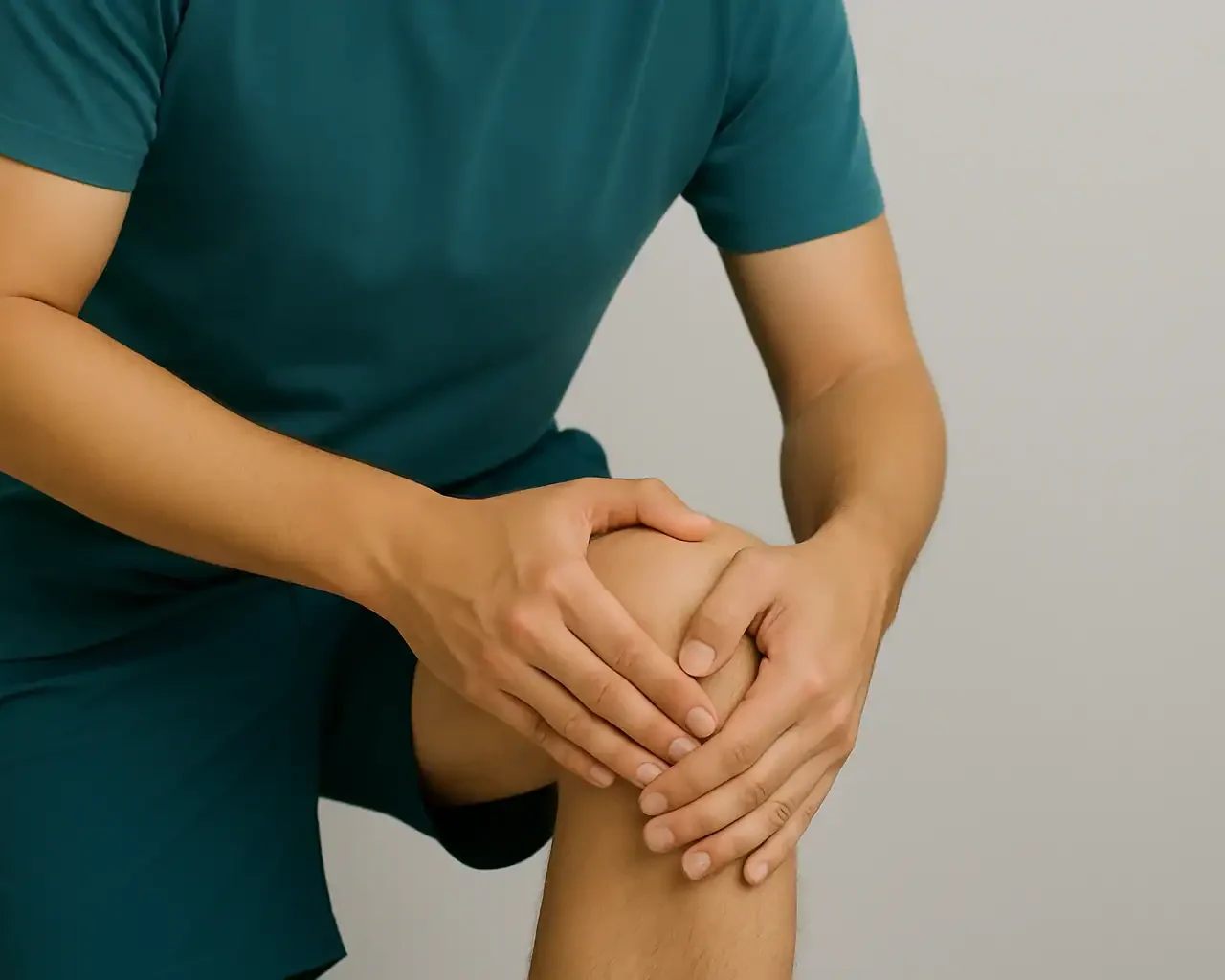
Knee injuries are among the most common problems in sports practice. They can occur in a sudden movement, such as a change of direction or a landing, but they can also develop gradually due to repeated loads for which the body is not yet prepared.
Not all injuries can be avoided. There are unpredictable situations, such as falls, collisions, or contact between athletes. Nevertheless, adequate physical preparation can reduce the risk of injury and improve the knee's ability to respond to the demands of training and competition.
Prevention does not depend on a single exercise, equipment or technique. It results from the combination of good load management, muscular strength, movement control, recovery and attention to the body's signals.
Why do knee injuries occur?
The knee supports and transmits forces during activities such as walking, running, jumping, braking, and changing direction.
During sports, these forces can increase significantly. To respond adequately, the body needs strength, mobility, coordination, and enough time to adapt.
The risk of injury can increase when there is:
- too rapid increase in the volume or intensity of training;
- insufficient recovery between sessions;
- accumulated fatigue;
- loss of strength;
- inadequate control during jumps, landings or changes of direction;
- a hasty return to sports after an injury;
- history of knee injuries;
- Physical preparation that is poorly adjusted to the demands of the sport.
These factors do not mean that the person will necessarily suffer an injury. They must be analyzed together and taking into account the modality, age, level of practice and clinical history.
Increase the training load progressively
One of the main pillars of prevention is load management.
The load corresponds to the set of requirements to which the body is subjected during training, games, competitions and other physical activities. It can include the distance covered, the weight lifted, the number of jumps, the speed, the duration or the frequency of the sessions.
When the load increases gradually, the muscles, tendons, ligaments, and bones have the opportunity to adapt. When this increase is too rapid, the recovery capacity can be exceeded.
This often happens when a person:
- resume training with the previous intensity after a break;
- it simultaneously increases the duration and frequency of the sessions;
- begins to run many kilometers without any previous preparation;
- adds intense training without reducing other loads;
- participates in several competitions within a short period;
- ignores persistent symptoms to fulfill the training plan.
The progression should take into account not only planned training but also the person's recovery status. The same stimulus may be well tolerated in one week and excessive in another, depending on sleep, stress, diet, fatigue, and other activities.
Maintain a regular strength program
Strength training helps the body tolerate the loads associated with sports.
In the case of the knee, it is not enough to strengthen only the quadriceps. The stability and control of the lower limb depend on the coordinated action of different muscle groups.
A prevention program may include exercises for:
- quadricycle;
- ischiotibial;
- twins;
- glutes;
- hip muscles;
- trunk muscles;
- muscles of the foot and ankle.
Exercises such as squats, pelvic lifts, deadlifts, step-ups, lunges, and twin lifts can be part of the program. The selection depends on the person's ability, the modality practiced, and the goals of the training.
The most important thing is not to create a fixed list of exercises; the key is to apply an appropriate load and increase it progressively, while maintaining controlled execution.
For adaptation to occur, the training must be sufficiently demanding. Exercises always performed with very light loads may not prepare the body for the high forces present in running, jumping, or changing direction.
Training for jumps and landings
In sports such as football, basketball, volleyball, handball, tennis or athletics, the knee needs to absorb high forces during jumps and landings.
For this reason, preventive training should prepare the person for these requirements.
The progression can begin with:
- small jumps in the same place;
- jumping with both feet;
- controlled landings;
- jumps in different directions;
- single-leg jumping;
- movements performed at higher speed;
- Tasks involving a reaction to external stimuli.
During landing, it is important to be able to control the trunk, hip, knee, and ankle. The person must be able to absorb the force without losing balance or exhibiting uncontrolled movements.
However, there is no single correct way to land. The technique must be analyzed based on the movement, the modality, and the individual characteristics.
Practicing changes in direction and decelerations
Many ligament injuries occur when the athlete stops or changes direction quickly.
Often, training programs focus more on accelerating than on slowing down. However, braking in a controlled manner is essential to reduce the excessive load on the knee.
The training can include:
- progressive braking;
- previously defined direction changes;
- changes in direction in response to a stimulus;
- agility exercises;
- movements with different speeds;
- tasks performed under controlled fatigue conditions.
The difficulty should gradually increase. Before introducing quick and unpredictable exercises, the person should demonstrate sufficient strength and control in simpler tasks.
Carry out a structured warm-up
The warm-up prepares the body for the demands of the session.
Adequate warming up should not consist only of running for a few minutes or performing static stretches. It should include movements related to the activity to be performed.
It can be integrated with:
- light running;
- dynamic mobility;
- strength exercises;
- balance;
- jumps;
- accelerations;
- slowdowns;
- changes in direction;
- specific gestures of the modality.
The intensity should gradually increase until it approaches the demands of training or competition.
Structured warm-up can also serve as a small preventative program. When performed regularly, it allows you to work on strength, balance, coordination, and technique without requiring an additional session.
Respect the recovery periods
Adaptation to training does not only occur during exercise; it also occurs during recovery periods.
When a person trains repeatedly without recovering, a decrease in strength, coordination, and the ability to control movement can occur. Fatigue can alter the running technique, landing, or the response to a change in direction.
Recovery includes:
- sleeping the necessary number of hours;
- alternating more intense sessions with lighter ones;
- scheduling days off;
- avoid sudden increases in the frequency of training sessions;
- maintain adequate nutrition and hydration;
- adapt the training when there is accumulated fatigue;
- consider professional, academic or personal stress.
The body does not completely distinguish the stress caused by training from the stress associated with the other areas of life. A demanding week away from sports can reduce the recovery capacity, even when the training plan remains the same.
Monitor pain, fatigue and performance changes
Pain should not be the only indicator used to decide whether a person can continue training. However, persistent symptoms should not be ignored.
It is important to note:
- pain that increases over the sessions;
- swelling after training;
- stiffness the next day;
- feeling of instability;
- loss of strength;
- difficulty performing previously easy movements;
- reduction in speed or jumping ability;
- fatigue that does not improve with regular rest;
- change in confidence in the knee.
Some mild and transient responses may be part of the adaptation to exercise. The problem arises when the symptoms gradually increase, persist for several days or begin to limit function.
Recording the training load and the body's response can help identify patterns. A simple scale of perceived effort, along with the duration of the session, allows for tracking weekly demand without the need for complex equipment.
Correcting relevant limitations
An evaluation can identify limitations that increase the difficulty of certain movements.
Among the aspects that can be analyzed are:
- ankle mobility;
- hip mobility;
- strength of the lower limb;
- balance;
- control of the trunk;
- ability to jump and land;
- running technique;
- tolerance to load;
- functional differences between the members.
Not all asymmetries need to be corrected. Small differences between the sides are common and may not have clinical significance.
The intervention should focus on the limitations that affect function, cause symptoms, or make it difficult to perform the tasks required by the modality.
Choosing specific exercises for the modality
A prevention program must approach the real requirements of the sport.
A runner needs to tolerate repeated impacts and maintain the ability to produce force during many passes. A footballer needs to accelerate, brake, jump, rotate, and change direction. A strength athlete needs to control external loads in different ranges of amplitude.
Therefore, a generic program may not be sufficient.
Prevention should consider:
- the most frequent movements of the modality;
- the intensity of the actions;
- the duration of the efforts;
- the recovery periods;
- the training area;
- the footwear and equipment used;
- the training and competition schedule;
- the position or function played by the athlete.
The closer the preparation of the real requirements is, the greater the ability to transfer the gains to the sporting practice will be.
Continuing prevention after an injury
Having suffered an injury previously can increase the risk of a new episode, especially when recovery was incomplete.
A common mistake is to stop strength training and control once the pain goes away or when the person returns to training.
The absence of pain does not necessarily mean that the knee has regained all its ability. Deficiencies in strength, endurance, power or confidence may persist.
After returning to sports, it is important to maintain:
- strength training;
- balance and control exercises;
- progressive exposure to jumps and changes of direction;
- load monitoring;
- recovery strategies;
- functional reassessments when necessary.
Preventive work should become part of the training routine, and not just a temporary response to an injury.
Is there an exercise that prevents all injuries?
There is no single exercise that can prevent all knee injuries.
Similarly, no program can completely eliminate risk. The goal of prevention is to reduce modifiable factors and increase the body's ability to respond to the demands of sports.
The best results come when different components are combined:
- progressive load management;
- strength training;
- jumping and landing training;
- practice of slowing down and changing direction;
- structured heating;
- adequate recovery;
- monitoring of symptoms;
- continuity of the program throughout the season.
Consistency is usually more important than complexity. A simple program that is carried out regularly can be more useful than an extensive strategy that is abandoned after a few weeks.
When should I see a physiotherapist?
A physical therapy evaluation can be useful when there is:
- persistent pain in the knee;
- recurring swelling;
- feeling of instability;
- difficulty in returning to training;
- history of ligament or meniscus injuries;
- fear of jumping, running or changing direction again;
- decreased performance without an obvious cause;
- the need to prepare for a test or competition;
- interest in developing an individualized preventive program.
The assessment allows identifying the requirements of the modality, analyzing the current physical capacity and defining an appropriate progression.
Prevention is preparing the body for sports
Preventing an injury to the knee does not mean avoiding all effort. It means preparing the body to tolerate that effort.
A healthy knee does not just need mobility or the absence of pain. It needs strength, the ability to absorb load, control of movement and progressive exposure to the real tasks of the sport.
At Integrativa, in Restelo, Lisbon, Sports Physiotherapy includes the assessment of strength, mobility, motor control, functional capacity and training load.
Based on this assessment, it is possible to develop an individualized prevention program, adapted to the modality, the level of practice, and the individual’s history.
If you feel discomfort in your knee, are returning to sports, or want to reduce the risk of injury, schedule an assessment with a Sports Physiotherapy provider.
David Brandão | Osteopath and Physiotherapist
Physiotherapist Card: 3652 | Order of Physiotherapists // Osteopath Card: C-0031697 | ACSS
Integrativa | Health and well-being as a lifestyle
This website and its content are for information purposes only and are not a substitute for medical or health professional advice. Each person's treatment should be individualised and guided by health professionals. Do not make any changes to your treatment without contacting the doctor or health professional accompanying you.
Related articles