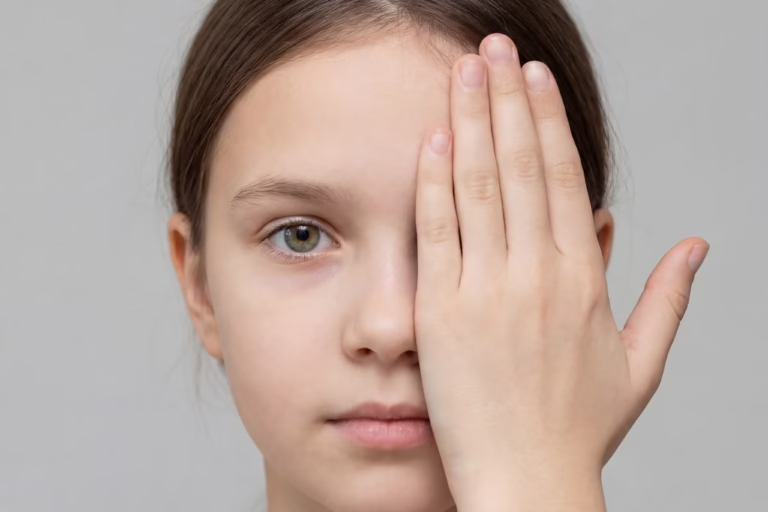



Recovery from facial paralysis does not depend solely on time. The way facial movement is monitored and re-educated through the different phases can influence the quality of the function recovered.
When the facial nerve is affected, the muscles responsible for facial expression may partially or totally lose their ability to contract. As nerve function returns, facial movement may also progressively reappear. However, recovery does not always occur in a perfectly coordinated manner.
It is during this period that difficulties such as asymmetry, stiffness, involuntary movements or synkinesis may arise. Therefore, the approach must adapt to the evolution of facial function and not be limited to performing generic exercises.
An expert assessment makes it possible to understand which stage of recovery the person is at, which movements are available, and what strategies may be appropriate at each moment.
What to do during facial palsy recovery?
Seek an appropriate assessment at an early stage
Facial paralysis, especially when it appears suddenly, must be clinically evaluated to determine its cause and exclude other neurological conditions.
The initial assessment also makes it possible to identify situations that require specific attention, such as difficulty closing the eye. When the eyelid does not adequately protect the cornea, eye protection must be a priority and accompanied by a healthcare professional such as an ophthalmologist.
Physiotherapy can integrate monitoring from the early stages, according to the cause, the severity of the impairment and the evolution of facial function.
Monitor the recovery of movement
Recovery of the facial nerve does not necessarily follow a linear course. Movements may develop gradually and vary in terms of strength, range of motion and coordination.
Therefore, it is important to monitor not only whether there is movement, but also the way in which that movement is carried out.
Regaining a smile, for example, does not simply mean being able to move one’s mouth. It is equally important to determine whether the movement is selective, whether there is involuntary eye movement, and whether there is excessive tension in other areas of the face.
Prioritise movement quality
In facial rehabilitation, the quality of movement is more important than the quantity.
The aim is not to perform movements that are progressively larger or stronger, but to regain coordinated and selective movements.
Facial neuromuscular re-education must therefore be tailored to each individual’s ability. Depending on the stage of recovery, small-range movements may be used, performed slowly and in a controlled manner, with the aim of improving precision and reducing the unnecessary involvement of other muscles.
Adapting the exercises to the recovery phase
Exercises should not be selected without taking clinical progress into account.
A person who still has limited muscle activity is in a different situation from someone who has already regained movement but still experiences stiffness or synkinesis.
As facial function changes, the aims of rehabilitation should also change. What is appropriate in the early stages may no longer be suitable when new patterns of movement emerge.
Work on the ability to relax
Facial recovery is not just about activating the muscles. In some situations, it is equally important to regain the ability to relax them.
During the recovery of nerve function, some muscles may remain overly active or contract during movements performed in other regions of the face. This situation can cause a sensation of tension and stiffness.
Relaxation training, combined with movement re-education, helps to reduce unnecessary muscle activity and improve the dissociation between different facial movements.
Watch out for the early signs of synkinesis
Synkinesis occurs when a voluntary movement triggers an involuntary contraction in another part of the face.
A frequent example is the involuntary closing of the eye when the person tries to smile. Movements in the mouth area can also occur during eye closure.
These signs should be taken seriously. The sooner they are identified, the sooner the facial re-education strategy can be adjusted.
The presence of synkinesis does not mean that recovery is complete. It means that the movement pattern needs to be assessed and addressed in a different way.
What to avoid during recovery?
Avoid generic facial exercises
One of the most common mistakes is to assume that any facial exercise is beneficial. Facial paralysis should not be treated using a fixed sequence of movements. The exercise regime should depend on the stage of recovery, the patient’s remaining function and the presence of synkinesis.
Making facial movements repeatedly, without realising how they are being performed, can reinforce unselective movement patterns.
Avoid fast, wide and repetitive movements without guidance
Making exaggerated movements or trying to move your face as vigorously as possible does not necessarily mean you will recover better.
When facial nerve regeneration is incomplete, different muscle groups may be activated simultaneously. Rapid, wide-ranging and repetitive movements can reinforce this simultaneous activation and hinder the recovery of more selective movements. The priority should be control of movement, rather than its intensity.
Avoid trying to regain your strength at any cost
The idea that it is necessary to “strengthen” the facial muscles as if they were just another muscle group can lead to inappropriate strategies.
Facial function depends primarily on coordination between muscles. Achieving a stronger contraction does not necessarily mean achieving a more functional movement. At certain stages, the main aim is to learn how to activate one muscle without triggering the contraction of others.
Avoid doing exercises found on the internet without first being assessed
There are countless videos and exercise programmes for facial paralysis available online. The problem is that a strategy that may be suitable for one person might not be appropriate for another. The cause of the paralysis, the stage of recovery, the amount of movement available and the existence of synkinesis are determining factors. Therefore, before starting specific exercises, it is important to understand the pattern of impairment present.
Avoid the indiscriminate use of electrical stimulation
Electrical stimulation should not be used automatically in the recovery of facial palsy. The facial nerve has a particularly complex neuromuscular organisation, and recovery must prioritise the quality and selectivity of movement.
Avoid ignoring facial tension and stiffness
When movement begins to return, some people focus exclusively on being able to smile or close their eyes again and do not recognise the tension that may arise in other areas of the face. Stiffness can be a sign of excessive muscle activity or of difficulty in separating certain movements.
In these situations, simply focusing on contraction may not be the best strategy. It is necessary to assess which muscles are being overworked and how to improve control of the movement.
Avoid sticking to the same exercises indefinitely
Facial recovery is a dynamic process. An exercise programme should not remain unchanged throughout the entire process. As new movements emerge, strength increases or synkinesias appear, the rehabilitation goals also need to be reviewed. Continuing to perform an exercise simply because it was recommended at an earlier stage may no longer be appropriate once facial function has changed.
What if synkinesias already exist?
The presence of synkinesis requires a different approach. At this stage, the aim is not to indiscriminately increase strength or the range of movement. It is necessary to work on the ability to perform specific movements without triggering involuntary contractions in other areas.
A person might, for example, manage to smile, but involuntarily close their eye when doing so. In this case, work should focus on the dissociation between the two movements and on controlling muscle activity. Retraining must be progressive and adapted to the individual pattern of synkinesis.
How long does recovery take?
There is no single timeframe for recovery from facial palsy. The evolution depends on the cause, the severity of the facial nerve injury, and individual factors. In Bell's palsy, many people experience significant recovery, while others may retain deficits or develop synkinesis.
Therefore, it is not appropriate to assess recovery solely by the number of weeks or months since the onset of paralysis.
It is more important to monitor the evolution of function: which movements have returned, how they are performed, whether there is any asymmetry, if involuntary contractions have appeared, and how these changes interfere with daily activities.
When should you seek a specialist evaluation?
Sudden-onset facial palsy should be clinically evaluated, especially when the cause has not yet been identified.
Expert assessment is particularly important when:
- There is difficulty in closing the eye completely;
- Recovery is not progressing as expected;
- Involuntary movements appear;
- Persistent stiffness or tension appears in the face;
- The asymmetry remains;
- There are difficulties during feeding or speech;
- Other neurological symptoms appear.
Eye protection deserves special attention when there is an inability to close the eyelid.
Understanding the recovery of facial paralysis from an integrative perspective
Recovery from facial paralysis does not simply consist of waiting for movement to return or performing as many exercises as possible.
The facial nerve needs to recover the ability to activate the muscles in a coordinated manner. When this recovery does not occur in a perfectly organised way, synkinesis, stiffness and associated movements can arise that interfere with facial function.
For this reason, rehabilitation must keep pace with progress and adapt to what the face is capable of at each stage.
More movement does not always mean better function. In many cases, the goal is to improve the accuracy, selectivity and control of the movement, while reducing unnecessary activity in other muscles.
An individualised approach makes it possible to identify what needs to be worked on and, equally importantly, what should be avoided. In facial palsy, knowing when to stimulate, when to control and when to reduce the intensity of movement is an essential part of proper functional recovery.
Alexandra Gomes | Physiotherapist specialising in the treatment and recovery of Facial Paralysis
member of the Facial Therapy Specialists International (FTSI)
Physiotherapist Card: 1459 | Order of Physiotherapists
Integrativa | Health and well-being as a lifestyle
This website and its content are for information purposes only and are not a substitute for medical or health professional advice. In all cases, treatments should be individualised and guided by health professionals. Do not make any changes to your treatment without contacting the doctor or health professional accompanying you.
Blog Articles