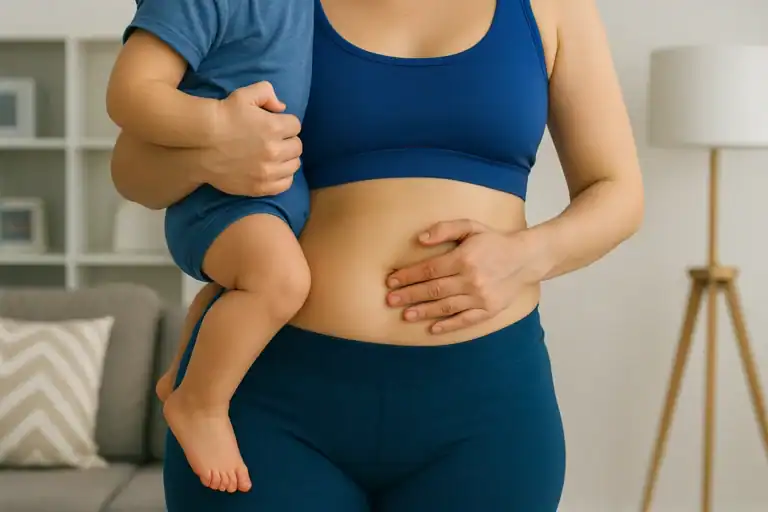


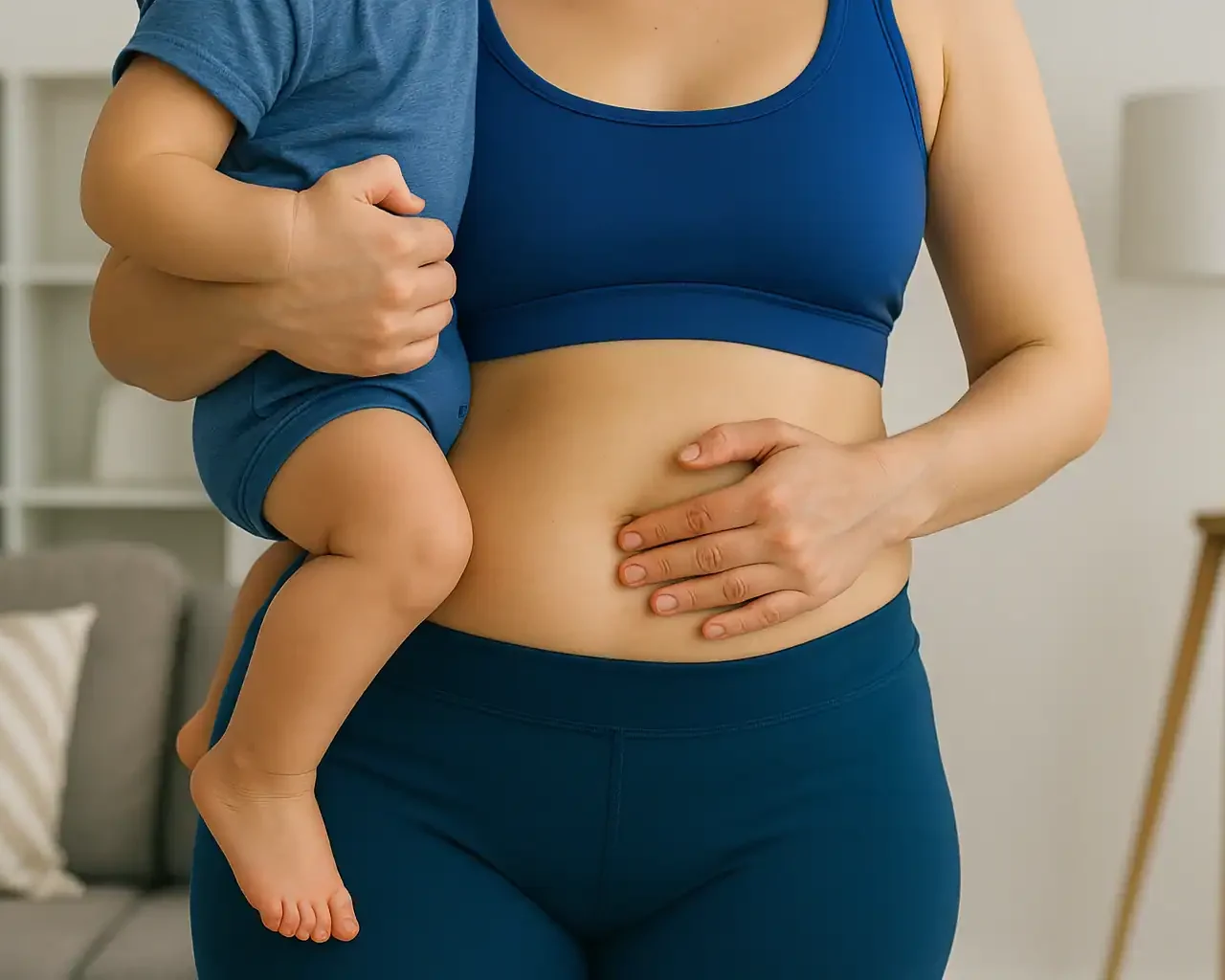
There are women who, a few weeks after giving birth, start to feel comfortable in their bodies again. Others need more time. And others continue to experience changes months later, even when, apparently, “everything should be fine” by now.
The belly is different. The scar is bothersome. The back or pelvis hurts. The pelvic floor doesn’t seem to respond the same way. There are urine losses, a feeling of heaviness, or discomfort during sexual intercourse. Returning to exercise isn’t going as smoothly as you hoped. Or there’s just a difficult-to-explain feeling: the body still doesn’t really feel like your own.
Physiotherapy after childbirth can play an important role in this process. Not only when there is a specific symptom, but also to understand the changes that have occurred and to monitor the progressive return to movement.
Postpartum does not end when the puerperium ends
There is a very common idea that, after the first six weeks, the body should already be recovering.
But six weeks does not mean that all the body’s structures have recovered or that all women should feel like they did before pregnancy.
Pregnancy and childbirth cause significant changes in the body. The pelvic floor, the abdominal wall, the pelvis, the spine, the tissues, and the scars undergo different processes of adaptation and recovery.
And there is another change that is often forgotten.
After giving birth, the woman begins to carry, feed, bottle-feed, and care for a baby. She sleeps less, spends a lot of time in certain positions, holds the baby numerous times a day, and may stop moving in the usual way.
The body is not only recovering from childbirth; it is also adapting to a completely different life.
Not everything should simply be accepted as “postpartum normalcy”
It is true that some changes are common after pregnancy and childbirth. But just because they are common doesn't mean they need to be ignored.
Losing urine when coughing, running, or jumping, feeling a weight in the pelvic region, having persistent pain, feeling discomfort during sexual intercourse, or difficulty resuming certain activities are situations that deserve evaluation.
It doesn't necessarily mean that there is a serious problem. It just means that there is a symptom that deserves to be understood. You don't have to wait for the discomfort to be intense or to interfere too much with daily life to seek help.
The pelvic floor also needs to recover
During pregnancy and childbirth, the pelvic floor undergoes significant changes.
Then you need to get back to doing very different tasks: picking up the baby, holding it in your arms, walking, running, jumping, training, or simply standing for several hours.
Therefore, recovering the pelvic floor does not just mean having contractions.
It is important to understand how muscles contract, but also how they relax, how they coordinate with breathing and with the abdominal wall, and how they respond to the different demands of everyday life.
It is here that pelvic physiotherapy after childbirth can play an important role: in assessing the function of the pelvic floor, in restoring muscle coordination, and in gradually returning to the activities that are part of each woman’s life.
A good recovery isn’t just about contracting a muscle; it’s about using it in a way that’s appropriate to what the body needs.
And the abdominal diastasis?
Abdominal diastasis is one of the changes that most concern some women after pregnancy. But a diastasis is not just a matter of measuring how many centimeters there are between the abdominal rectus muscles. It is also important to understand how the abdominal wall works, how it generates pressure, and how it responds to movement and different loads.
Two women can have a similar distance between their muscles and experience completely different experiences. Therefore, assessing the functioning of the body is more important than looking at a number alone.
Physiotherapy can help assess the abdominal wall and guide the progression of movement and exercise according to the needs of each woman.
The scar is also part of the body
A cesarean scar, episiotomy scar, or a laceration is not just a mark on the skin. Depending on the case, there may be changes in sensitivity, tissue mobility, tension, or discomfort. The scar should be observed in the context of the entire body and not in isolation.
Similarly, a cesarean section does not mean that recovery should focus solely on the abdomen; just as a vaginal delivery does not mean that the focus should only be on the pelvic floor. The body functions as a whole.
Physiotherapy can integrate the assessment of the scar with the rest of the body's function, taking into account the symptoms and the activities that the woman intends to recover.
When sexual intercourse becomes uncomfortable
Pain or discomfort during sexual intercourse can also be part of the experience of some women after childbirth.
Changes in the tissues, dryness, scarring, muscle tension or fear of movement can contribute to this experience.
But that doesn't mean the woman has to get used to the pain.
When there is persistent discomfort, understanding what is contributing to it can be the first step in finding an appropriate way to address it.
Pelvic physiotherapy can be part of this evaluation, always integrated into the woman's individual history and needs.
Returning to exercise is also a recovery
After childbirth, there may be a desire to quickly regain strength or return to the exercise that was done before pregnancy. But recovery is not a race.
Exercise can be part of the postpartum period and is important for physical and mental health. However, progression should take into account each woman's history, the type of delivery, the present symptoms, the previous level of activity, and what you intend to resume doing.
There is no single moment when all women are ready to run, jump, do certain exercises, or return to the previous training routine.
There is a path between rest and a full return to activity, and this path can be different for each woman. Physiotherapy can help assess this path and define an appropriate progression, respecting the body's response.
When is it worth seeking evaluation?
It is not necessary to be “very ill” to seek help. Persistent pain, loss of urine or stool, a feeling of pelvic heaviness, discomfort during sexual intercourse, changes in the scar, difficulty resuming exercise, or simply the feeling that the body is not responding as it used to are valid reasons to seek evaluation.
The assessment can be done as part of postpartum physiotherapy, including, when indicated, a pelvic physiotherapy approach. And it is not necessary to wait for a serious problem to exist, but to understand what has changed and how the body can be helped to adapt again.
Recovery does not mean returning to the body of before
Perhaps this is one of the most important ideas. The goal of postpartum recovery doesn't need to be to recover the body that existed before pregnancy. That body went through a tremendous experience.
The goal may be another: to feel comfort, confidence, and security in one's own body again; to walk again without pain; to run again without losing urine; to be able to hold the baby without feeling pain in the back; to feel strength again; to resume exercise in a progressive way; to feel comfortable in sexual relations; to feel the scar as part of the body, without it determining what is possible to do. These are different goals for each woman.
Listening to the body does not mean being afraid of it
After becoming a mother, it’s easy to start interpreting every feeling as something that “went wrong”. But the body doesn’t need to be seen as a problem to be taken care of. It needs to be observed. Recognizing what has changed, what bothers you, what has improved, and what we still haven’t been able to do as we would like can be the first step towards a more conscious recovery.
Because postpartum is not just the period when the body recovers from childbirth. It is also the period when a woman learns to know her body again, this time after everything has changed.
And maybe the question isn’t “When will my body return to normal?” Maybe it’s “What is my body trying to tell me?”
Taking care of the body after becoming a mother is also giving space to that question.
In Integrative Medicine, postpartum physical therapy and pelvic physical therapy allow for the individualized assessment of the changes and symptoms that may arise after pregnancy and childbirth. The follow-up is tailored to the needs, goals, and pace of each woman, promoting a gradual and safe return to daily activities and exercise.
Alexandra Gomes Physiotherapist specialising in Pelvic Physiotherapy
Physiotherapist Card: 1459 | Order of Physiotherapists
Integrativa | Health and well-being as a lifestyle
This website and its content are for information purposes only and are not a substitute for medical or health professional advice. In all cases, treatments should be individualised and guided by health professionals. Do not make any changes to your treatment without contacting the doctor or health professional accompanying you.
Blog Articles