


The arrival of a baby marks the beginning of a profoundly transformative phase, with physical, emotional and functional impacts. Postpartum is a period of progressive adaptation, during which a woman's body needs time, appropriate monitoring and rehabilitation strategies that respect the physiological processes underway.
Clinical Pilates in the postpartum period is a safe and well-founded clinical intervention aimed at functional recovery, comfort in movement and reorganisation of the musculoskeletal and neuromotor systems, respecting the individual rhythm of each woman.
Changes in a woman's body after giving birth
During pregnancy and childbirth, the female organism undergoes profound adaptations that don't automatically resolve after the baby is born. In the postpartum period, changes such as the following often persist or become more evident:
- Postural changes, associated with the displacement of the centre of gravity and overloading of the spine, often aggravated by repeated gestures such as breastfeeding, holding and caring for the baby;
- Abdominal diastasis, characterised by the separation of the rectus abdominis muscles, which requires a specific process of neuromuscular re-education and progressive strengthening guided by clinical criteria;
- Changes in the pelvic floor, common after childbirth, which can be manifested by a feeling of instability, pelvic discomfort or episodes of urinary incontinence;
- Decreased strength and muscle tone, related to hormonal changes, a temporary reduction in physical activity and an increase in the functional demands of everyday life.
Recognising these changes is essential for guiding a safe, effective recovery that is adjusted to the body's real needs in the postpartum period.
Clinical assessment as a starting point
Before starting Clinical Pilates, a detailed clinical assessment is carried out, which includes postural observation, respiratory function, activation of the core, These include pelvic floor function, joint mobility and movement patterns.
This assessment makes it possible to identify priorities, define functional objectives and adjust progress, guaranteeing an individualised and clinically informed approach.
In cases of caesarean delivery, the mobility of the scar and adjacent tissues is also taken into account, since these structures influence posture, control of the core and the overall organisation of the movement.
Objectives of Clinical Pilates in the postpartum period
Clinical Pilates in the postpartum period focuses on the functional rehabilitation of the body, not just the recovery of physical fitness. Through specific, adapted and clinically orientated exercises, this approach seeks to:
- Recover strength, stability and motor control;
- Improve posture and efficiency of movement;
- Reduce muscle and joint discomfort associated with the demands of the postpartum period;
- Promote greater body confidence and physical and emotional well-being.
It's a structured process that respects postpartum physiology and favours the quality of movement over intensity.
How Clinical Pilates supports postpartum recovery
Clinical Pilates intervention is based on principles of control, precision and breathing, with specific benefits in this context:
- Re-education of core and the pelvic floor, through the integrated work of the deep abdominal muscles, the diaphragm and the pelvic floor, essential structures for lumbar-pelvic stability and continence;
- Gradual resumption of physical activity, allowing a progressive return to movement, respecting tissues that are still adapting and reducing the risk of overload;
- Improving posture and reducing pain by correcting altered patterns that contribute to complaints in the lumbar, cervical, dorsal and shoulder regions;
- Benefits in terms of emotional wellbeing, since the conscious movement associated with breathing favours the regulation of the nervous system and helps to manage stress. stress.
Functional recovery is based on the real demands of everyday life, such as holding, breastfeeding, carrying a baby or sitting for long periods, promoting more efficient and sustainable movement patterns.
Factors such as fatigue, fragmented sleep and mental load are also taken into account when planning sessions, as they influence the body's ability to adapt.
Clinical Pilates with Reformer in the postpartum period
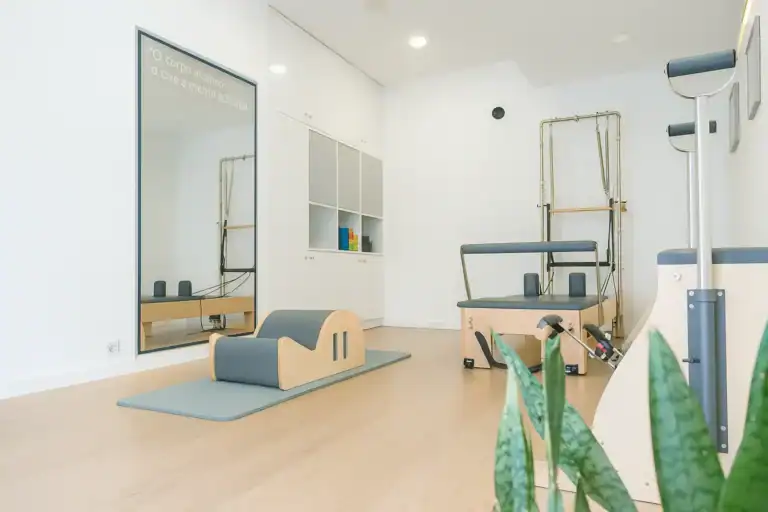
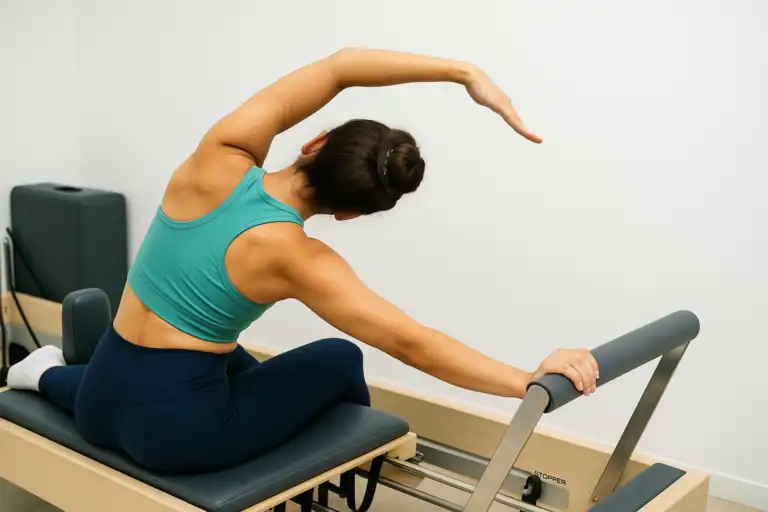
Clinical Pilates with Reformer uses equipment with spring systems that allow the resistance, support and range of movement to be precisely adjusted. In the postpartum period, this translates into greater control and safety in execution, gradual progressions adjusted to the individual's state of recovery, additional support in the organisation of movement and body perception, and balanced development of strength, coordination and overall stability.
Whenever clinically appropriate, the sessions can be adapted to the mother's new routine, integrating the practical demands of this phase.
When to start Clinical Pilates after giving birth
Clinical Pilates in the postpartum period should be started after medical authorisation, taking into account the type of birth, vaginal or caesarean, and the individual's state of recovery.
In many cases, it's possible to start with gentle, low-demand exercises, progressively evolving as the body regains strength, stability and confidence in movement.
Clinical Pilates in the postpartum period is suitable for all women
Clinical Pilates can be integrated into different postpartum contexts. Each programme is individualised based on a detailed clinical assessment, allowing specific needs, limitations and functional goals to be identified.
Monitoring by physiotherapists trained in this area ensures respect for the individual rhythm, the changes inherent in the postpartum period and the real demands of a woman's day-to-day life.
Understanding the postpartum period from an integrative perspective
Caring for the body in the postpartum period is part of an overall health concept. Creating space for an informed and gradual recovery contributes not only to physical function, but also to emotional balance and quality of life in this transitional phase.
Postpartum is a period of continuous reorganisation, in which the body and nervous system adjust strengths, functions and movement patterns. Recognising this time as a progressive process, rather than a goal to be achieved quickly, is crucial for a sustainable recovery in line with female physiology. Creating space to listen to your body, move with awareness and respect your own limits contributes to greater physical and emotional balance in this transitional phase. Taking care of yourself is also taking care of your baby.
Alexandra Gomes | Physiotherapist and Clinical Pilates Instructor by APPI
Physiotherapist Card: 1459 | Order of Physiotherapists
Integrativa | Health and well-being as a lifestyle
This website and its content are for information purposes only and are not a substitute for medical or health professional advice. In all cases, treatments should be individualised and guided by health professionals. Do not make any changes to your treatment without contacting the doctor or health professional accompanying you.
Related articles